


Pros
- Stunning adults-only luxury resort with all-inclusive packages
- Extraordinary architecture and design
- Eco-friendly suites have trademark open-wall design and stunning views
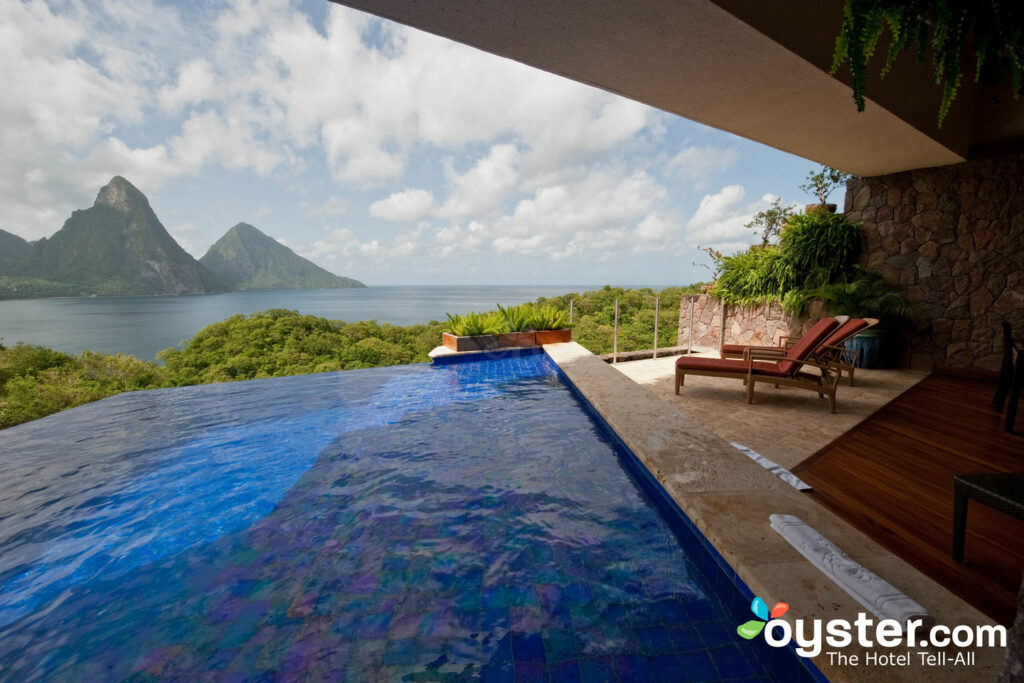
- Most rooms come with private infinity pools
- All units have canopy beds and chromotherapy whirlpool tubs
- Excellent service and dedicated butlers (cell phones are provided)
- Impressive food and wine; meal plans available
- Sky deck for cocktails and stargazing
- Spa treatments, bike rentals, and free daily yoga
- Beaches, snorkeling, kayaks, paddleboards, and a dive center within a short shuttle ride (or hike)
- A helicopter pad and shuttle service around the resort
- Wedding and honeymoon packages
- Free Wi-Fi
Cons
- Not all rooms have infinity pools, and the shared pool is in the restaurant
- Spa services receive mixed review
- Toilets in the rooms offer no privacy
- No TVs, air-conditioning, or radios (a pro for some!)
- Getting to the closest beach requires a steep climb or free shuttle
- Birds and bugs might be a nuisance
- Long, bumpy drive to reach
Bottom Line
The luxurious Jade Mountain is one of the most romantic resorts not only in the Caribbean, but the world, thanks to its incredible Piton views and extraordinary design. The 29 enormous suites, called "sanctuaries," are hands down the highlight; through the innovative, open fourth wall, each has a view of a sea from the entire room -- from the canopied bed, raised whirlpool tub, and (in all but the entry-level category) private infinity pool. Organic cuisine is served from a chic open-air restaurant, and guests can expect unwavering peace and quiet throughout (there are no TVs or children). Food is well-regarded and all-inclusive packages add value. Though there is no beach, guests can take a short shuttle ride or hike down to use the two beaches, free water sports, and dive center at sister property Anse Chastanet. All in all, Jade Mountain is well worth the price and bumpy ride to get there. Families -- our couples looking for easier beach access -- should consider Sugar Beach, a Viceroy Resort.
Hotel & Amenities Photos


Amenities
- Cribs
- Fitness Center
- Internet
- Jacuzzi
- Pool
- Spa
Oyster Awards
- Best All-Inclusive Resorts in the Caribbean
- Best All-Inclusive Resorts in Soufriere, Soufriere Quarter
- Best Boutique All-Inclusive Resorts in the Caribbean
- Best Luxury Hotels in Soufriere, Soufriere Quarter
- Best Beach Hotels in Soufriere, Soufriere Quarter
- Most Romantic Hotels in Soufriere, Soufriere Quarter
- Best Boutique Hotels in Soufriere, Soufriere Quarter
What Are the Design and Scene Like at the Jade Mountain Resort?
One of the world's most romantic, and expensive hotels; best suited to privacy-seeking couples who appreciate quiet luxury, a bit of ruggedness, and impeccable service
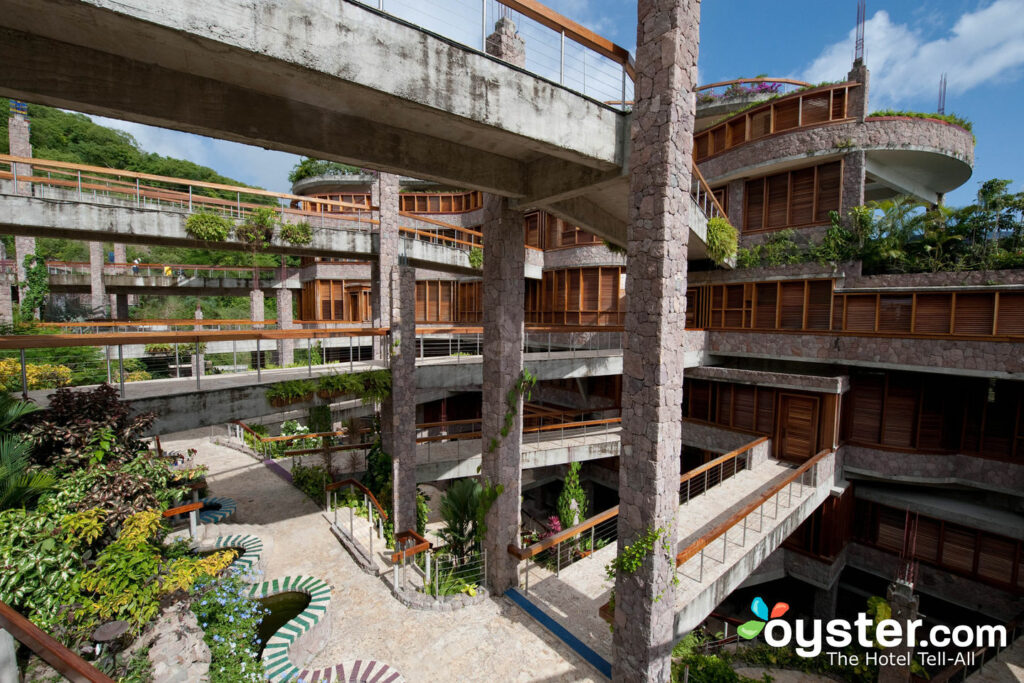
Jade Mountain Resort is an architectural marvel in the Caribbean. In an effort to respect but not submit to environmental confines, owner-architect Nick Troubetzkoy built the entire resort like a tabletop, braced it against a mountain about 75 to 100 feet above the shore, and pointed it at St. Lucia's iconic Pitons, poking through the Caribbean Sea. Each of the 29 guest rooms shares the stunning view beyond its missing "fourth wall." In order to fit a whirlpool tub with an underwater light show ("chromatherapy"), a sundeck, and, in most rooms, a private infinity pool, Troubetzkoy simply quintupled the size of a typical guest room. And yet the luxury is in the details -- a constant water filtration process that keeps the pools from stinking up the rooms; a network of ceiling fans keeps the rooms from being too warm (there's no AC); and the suites are spaced far enough apart for honeymooners to join Jade in calling them "sanctuaries." Almost everyone who comes to this world-renowned, romantic boutique resort belongs to a cozy twosome celebrating a wedding, honeymoon, anniversary, or some other landmark event, and it's easy to understand why.
But Jade Mountain is not for everyone. First: No kids under the age of 16 are allowed. Second: The system of catwalks and hundreds of stairs (there are no elevators) makes it an impossible choice for anyone with mobility challenges. And the intimate, scenic serenity does have its tradeoffs. Just getting to the resort can take well over an hour on winding, nerve-racking roads. The closest beach is at Jade's sister resort, Anse Chastanet, about a five-minute shuttle ride or 300 or so stairs away. City slickers may have a hard time giving up their cell phones in public areas, and ladies will find no use for their heels here. This resort is better suited for young, sporty couples who want to experience laid-back luxury at its finest.
Taken together, it's hard to compare Jade Mountain to anywhere else on earth. But while its quiet, intimate, indisputably romantic atmosphere is unique, you can find a similar setting without sacrificing luxurious comforts at other boutique hotels like the Caves or the Geejam in Jamaica, or the Sivory in Punta Cana -- often for significantly less money. The suites at Tortuga Bay in the Dominican Republic might lack a private pool, but they're similarly sized and much closer to gorgeous beaches, private lagoons, golf courses, and the airport. And if you're looking to explore the Caribbean's natural beauty, you can stay in a room that walks right out onto the beach at Caneel Bay in the U.S. Virgin Islands, a resort surrounded by 7,000 acres of National Park.
Still, the level of service at Jade Mountain is extraordinary and tough to top -- from the turndown service to round-the-clock butlers called "Major Domos" assigned to each guest room, whose sole duty is to ensure that you have a flawless experience. Upon arrival, guests can expect to be greeted with cool peppermint-scented towels and a welcome cocktail, and check-in takes place inside the rooms. Those who arrive by helicopter will likely receive a personal welcome from the general manager himself. That said, once you're outside of Jade Mountain -- to visit Anse Chastanet's beach, for example -- service standards begin to wane. There's not much to the grounds beyond the rooms, restaurant, sky deck, and reception area, though Jade's sister resort -- a shuttle ride or hike downhill -- offers more amenities.
Where Is the Jade Mountain Resort Located in St. Lucia?
Getting to this hidden architectural marvel requires a rough road from the authentic Caribbean town of Soufriere, or a helicopter ride.
This 600-acre Jade Mountain Resort (shared with sister resort Anse Chastanet) is located on St. Lucia's southwestern Caribbean coastline, just past the town of Soufriere. It boasts incredible views, especially from Jade Mountain, which is built higher into the landscape -- about 300 steps above sea level. There are a smattering of resorts to the south, but most are concentrated near the beaches on the northwestern coast, making Jade Mountain feel a bit cut off.
How far is Jade Mountain from the airport? Reaching Jade Mountain Resort requires an adventurous, and at times terrifying, 90-minute drive from Hewanorra International Airport in Vieux Fort. Roads around the island are filled with hairpin turns, massive potholes, and serious inclines -- and the last 10 minutes of the journey will take you up a steep, one-lane dirt road. Finding the resort is also tricky (don't expect much in the way of signage); if you do rent a car, be sure to get four-wheel drive and exercise caution. Many guests choose to take a taxi or arrange a private driver; some even take a helicopter ride to the resort's own helipad, which will cut the travel time to the single digits. Once on-site, free shuttles are available to get around the grounds, or guests can hike and get a workout.
Unlike in more developed Caribbean islands, this area of St. Lucia doesn't offer much in the way of touristy dining, shopping, or nightlife, which is why many choose to stay here to begin with. Once you're at Jade Mountain, you'll likely stay here, unless taking a guided tour to Tet-Paul nature trail, the Diamond Falls, and La Soufriere Sulphur Springs. (These popular attractions are more convenient for guests staying in this area than those staying on the northwestern shore as they're all much closer to Soufriere than Castries). Those who want to explore other restaurants and bars can head to nearby luxury resorts Ladera and Viceroy -- both 15 minutes away by car. Other than this, guests can expect to isolated from virtually everything and everyone -- aside from a rooster crowing at dawn, or tree frogs singing their nightly chorus.
What Are Rooms Like at the Jade Mountain Resort?
Eco-friendly sanctuaries are intentionally tech-free, with no TVs or radios to disturb the peace or Piton views, and most have private plunge pools.
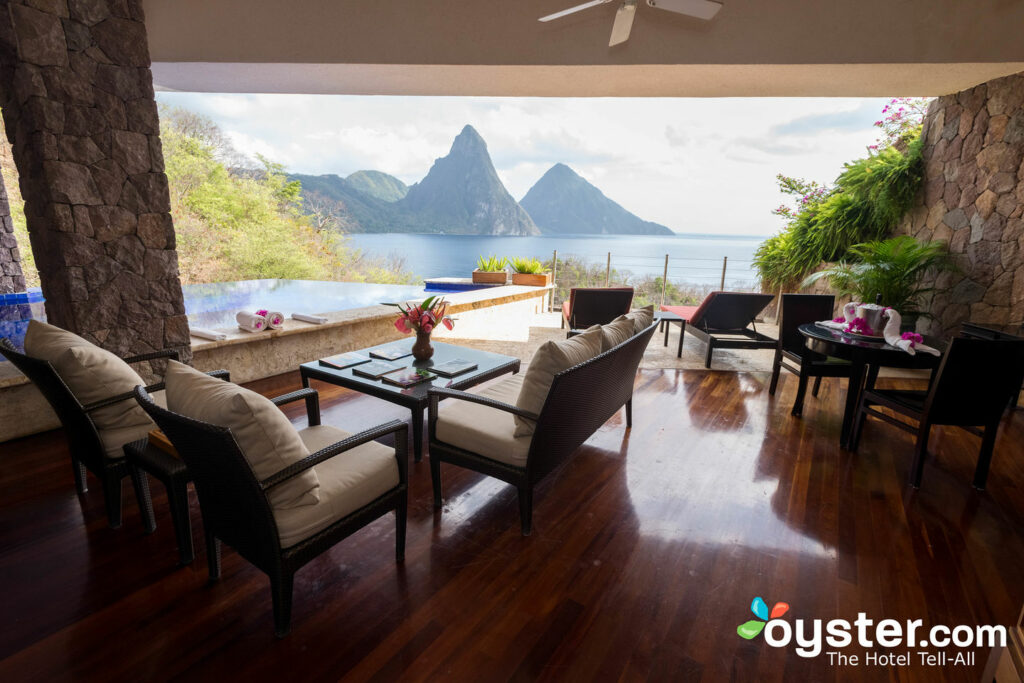
Few guest rooms around the world, can compare to those at Jade Mountain. While a select few architects have attempted to mimic the missing fourth-wall design, opening the rooms to the elements (and bugs), the seamless integration of the infinity pools (in all but the five Sky Jacuzzi Suites) and stunning views of the iconic Pitons and the Caribbean Sea give Jade's suites a considerable edge over the rooms at other leading Caribbean hotels, such as those at Caneel Bay in the U.S. Virgin Islands or the Caves and Round Hill resorts in Jamaica. Like these competitors, the guest rooms are intentionally tech-free -- no TVs or radios to disturb the peace (though there is Wi-Fi). You better love your company (or at least your book); there's little else to entertain.
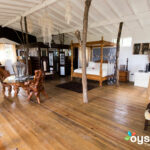
The 29 sanctuaries are all huge, with 15-foot ceilings, and categorized as Sky, Star, Moon, Sun, and Galaxy -- the latter being the largest. Interiors incorporate more than 20 different species of tropical hardwood (each one varies in appearance), and walls are made of coral plaster from Barbados. A network of ceiling fans keep the rooms from being too warm (there's no AC), and king-size four-poster beds come with mosquito netting -- both romantic and necessary. As there's no fourth wall, mosquitoes, other bugs, and birds can be a nuisance, especially in summer months. In addition to the netting, the resort also regularly fumigates and provides ample insect-repellant candles and plug-in devices.
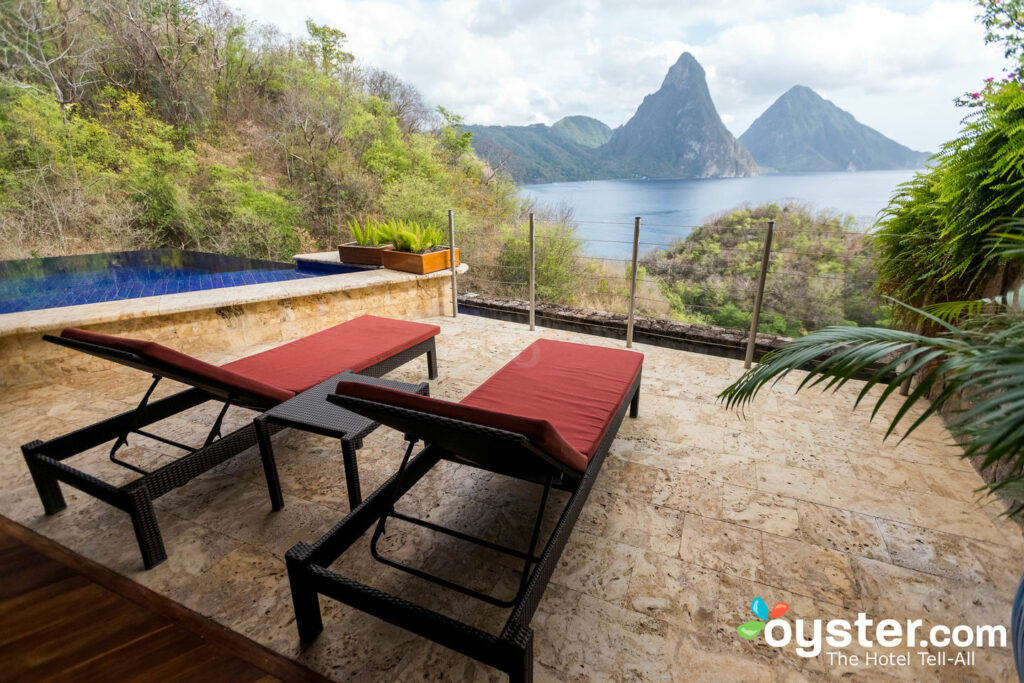
Each room also comes with a comfortable lounge area, dining table, minibar, and tea- and coffee-making facilities, as well as two cushioned sun loungers facing the sea and Pitons. Bathrooms, for their part, are massive, with double-vanity sinks, walk-in rain showers with six body sprays, Molton Brown toiletries, bathrobes, and slippers. Each chromotherapy whirlpool tub is mounted on a pedestal, and colors can be adjusted based on mood, like blue for calmness, or red to energize and activate blood flow. Nothing divides the bathroom (ahem, toilet) from the rest of the room, so couples might need to broaden their level of intimacy.
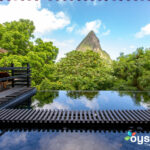
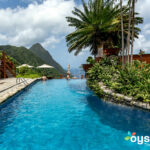
The built-in infinity pools are included in 24 sanctuaries, and range from 450 to 900 square feet -- the higher the room category, the bigger the pool. They are surfaced with glass tiles, and each pool (and correlating bathroom) has its own color scheme. Pool water is filtered and sterilized without chemicals about six times each day, so guests will never experience any algae buildup or chlorine stink in the rooms. Another romantic factor: Pools are equipped with fiber optics to illuminate them at night, which guests can control.
The five Sky Jacuzzi Suites are located on the lower hillside level of the resort. These are the only rooms without a built-in infinity pool, though they still boast 1,650 square feet of space and have the large chromotherapy whirlpools with views. One of the Sky Suites on the northeast corner has windows and air-conditioning.
Rooms are reached via private outdoor hallways; guests will know which hallway is shared (like the one to the restaurant), and which is private by the unique glass color system. A welcome spread with sparkling wine and fruit is provided for arrival, and evening turndown service might include a note from the manager, a surprise bubble bath, or beautiful towel art with some flower petals strewn on the bed.
What Features Are Available at the Jade Mountain Resort?
A public outdoor pool, spa services and a gym, free daily yoga classes, hiking trails, and mountain biking (all free), plus access to a sister resort's beach
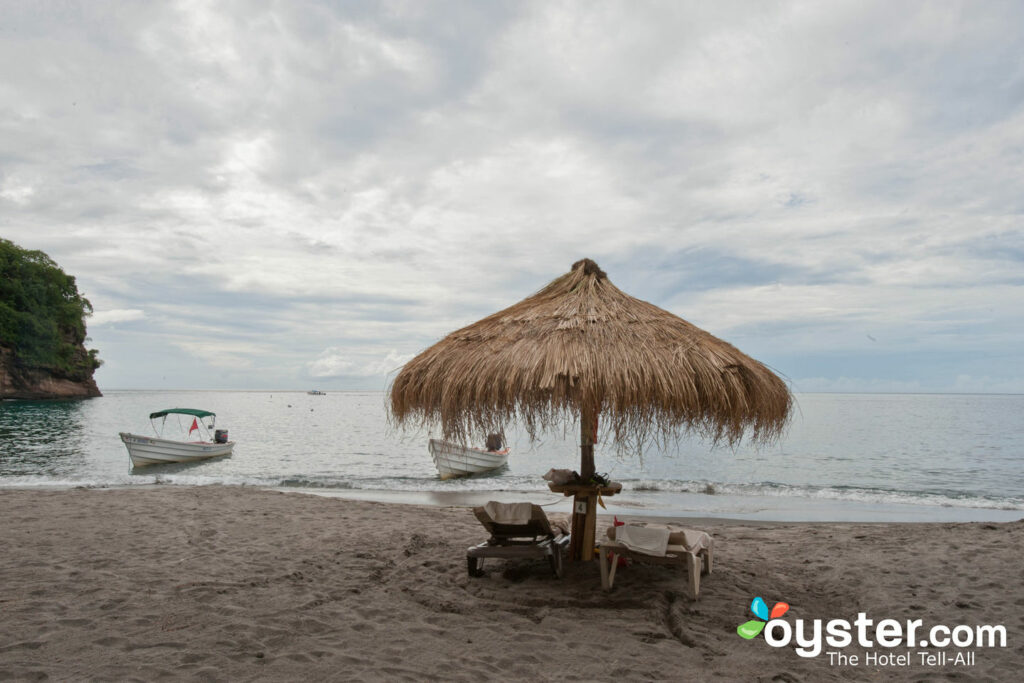
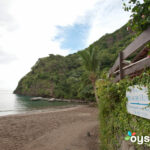
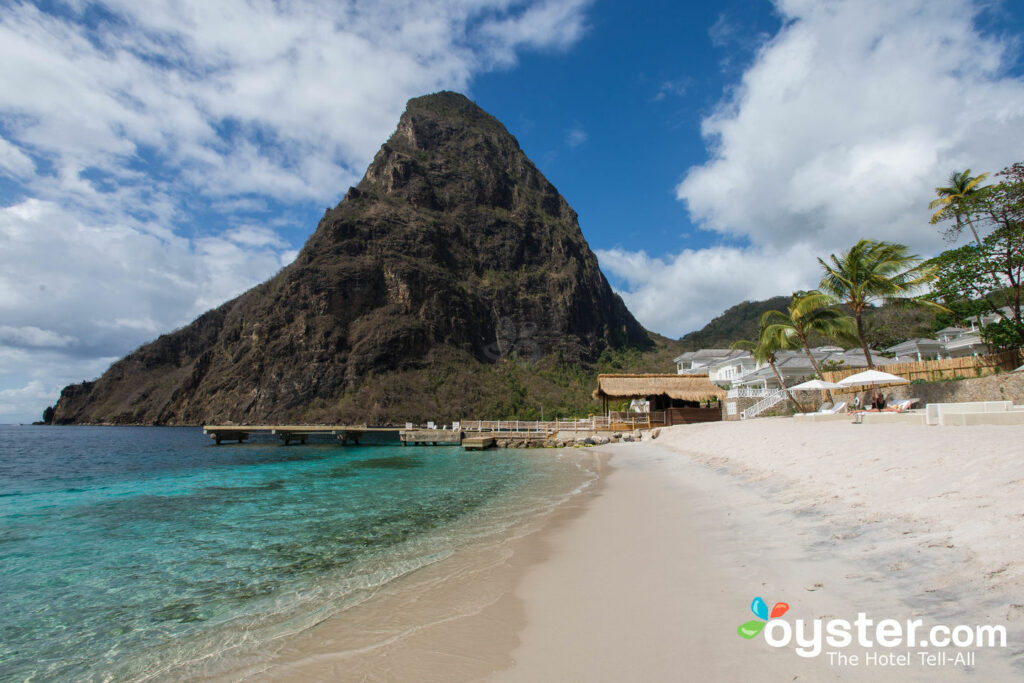
Guests have access to activities and facilities of Anse Chastanet, which is a hike downhill (or five-minute shuttle ride). The sister resort's two beautiful soft-sand beaches are dotted with sun loungers and umbrellas; guests can enjoy food and drink on their loungers (they just put up a flag when they want their order taken) or at the beachfront restaurant. This part of the sea offers pristine coral reefs for snorkeling, and the resort provides kayaks, stand-up paddleboards, and windsurfing (all free) -- though windsurfers should know the water tends to stay calm. Sailing, fishing, and snorkeling excursions are offered on a regular basis, and there's a PADI-certified scuba center with a full diving program. Just note that the sand is a bit darker than at Sugar Beach.
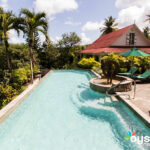
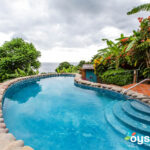
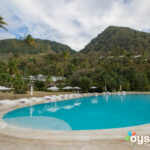
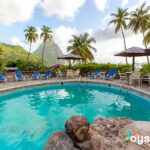
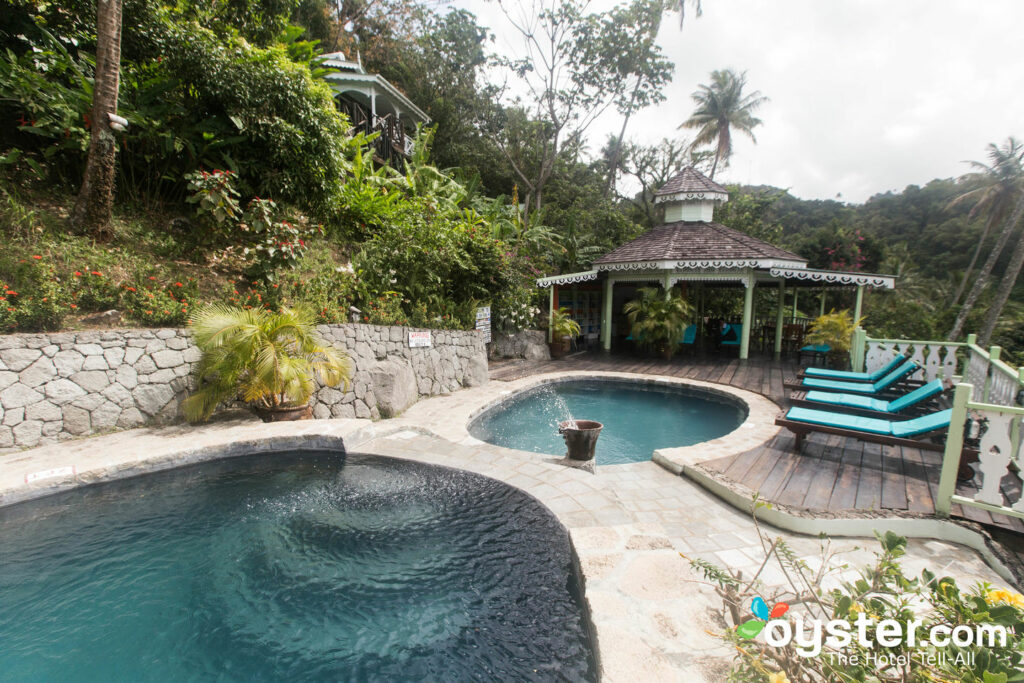
Back uphill at Jade Mountain is a shared infinity pool located in the restaurant, provided mostly for the Sky Suite guests who don't have pools -- though few actually use it.
There are multiple trails on the resort's 600 acres and surrounding area for hiking, walking, jogging, and biking, allowing guests to take in the magnificent scenery while enjoying some exercise. Daily escorted tours are led by Resort Guides, and are free with the exception of those that include transportation. Those who want to rent Cannondale mountain bikes can visit the biking center on-site. Some guests may opt to tour major attractions outside of the grounds such as the botanical gardens, Sulphur Springs (a volcano where travelers can drive right through the crater), and hiking tours up Gros Piton mountain.
The spa, Kai en Ciel, is fairly basic for a hotel in this price range -- with no sauna or steam room -- and treatment rooms are located next to reception. Many choose the in-room option instead. Spa services have received mixed reviews so serious spa-goers might prefer the Rainforest Spa at Sugar Beach. The fitness room with Cybex equipment is also small, but the view is incredible and personal trainers are available upon request. There are three (free) daily yoga classes -- one here and two and Anse every day but Saturday -- given by the resident yoga instructor; they are open to all levels.
Free Wi-Fi is available throughout the property and there is a desktop computer in the reception area. A concierge is also available to assist with any request beyond the scope of private butlers.
What Restaurants and Bars Are at the Jade Mountain Resort?
Local, organic produce grown on-site is used to prepare international cuisine for the well-regarded restaurants; all-inclusive meal packages are available.
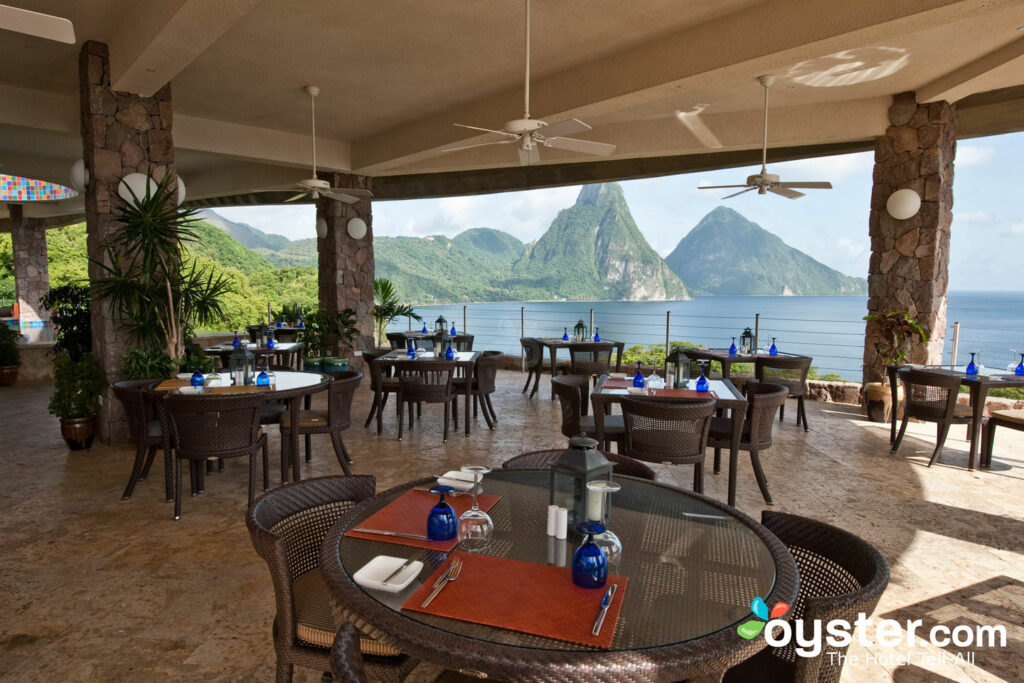
Anyone even slightly concerned with keeping the final bill in check might want to sign up for a meal package -- especially given the resort's seclusion. One option includes breakfast and dinner, and the other is all-inclusive, covering all meals and most drinks. Many guests report that the all-inclusive plan is the most cost-effective choice.
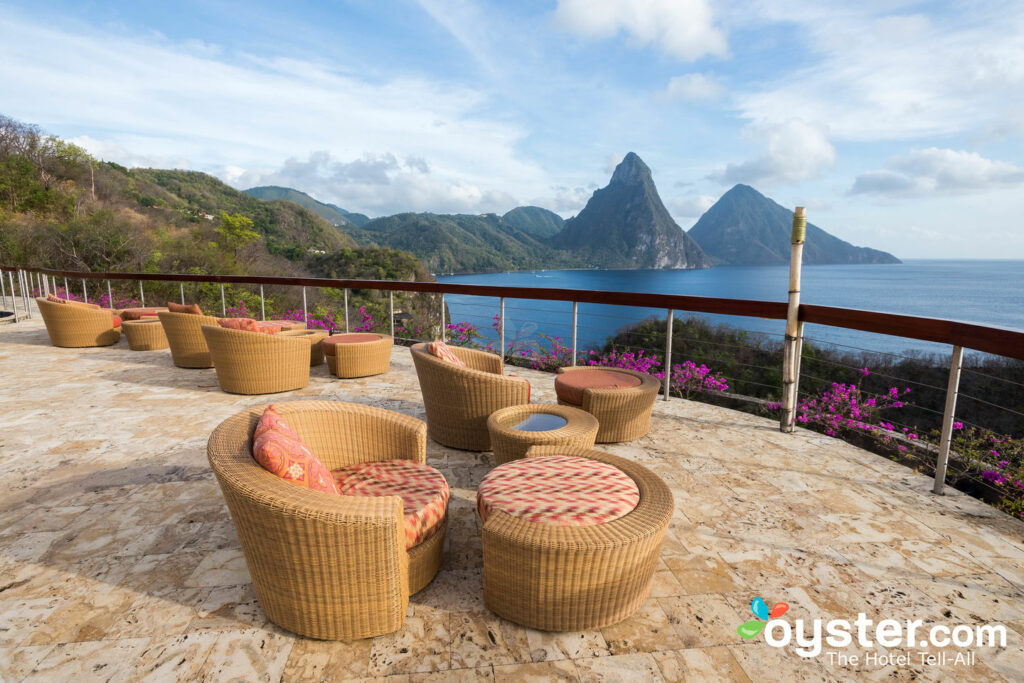
Jade Mountain Club is exclusive to guests of Jade Mountain Resort. The chic, open-layout restaurant has more of those stunning views, and the cuisine was conceptualized by James Beard Award winner Chef Allen Susser. It serves gourmet international fare (with seasonal influences) for all three meals, and the menu changes regularly (the dinner menu typically changes nightly). Guests can start and end the night with cocktails on the sky deck, and on some evenings there is live jazz or an acoustic guitarist. Guests who want privacy can order room service; staff will deliver a four-course meal and a bottle of wine. Private dining can also be arranged at other locations such as the beach down below.
Much of the produce is organically grown on the resort's Emerald Estate plantation -- the hotel offers tours of the gardens -- and the seafood is local, while beef is imported from the U.S. The food here is great, no doubt, but like anywhere in the Caribbean, the setting will often be more memorable than your food.
There are other high-quality restaurants a shuttle ride downhill at the Anse Chastanet resort, such as the Tree House restaurant (with Caribbean fare and great breakfasts), Emerald's (vegetarian cuisine), Trou du Diable (Caribbean and Creole food by the beach), and a beachfront vegetarian Indian restaurant, Apsara. In addition, the Jungle Grill on the Anse Mamin beach is known for its burgers -- it is accessible by kayak from the main beach and great for lunch.
Adventurous types who want to experience local culture can check out a handful of bars and restaurants in and around the authentic town of Soufriere. Ask the resort to provide transportation.
Our Favorite Gear and Outfits for St. Lucia
Caribbean Rookie Mistakes Outfit
Men’s Summertime Daywear



Our Favorite Gear and Outfits for St. Lucia



Women’s Warm Weather Outfit

Mens Beach Resort Essentials


Travel Gear Essentials

Related Hotels
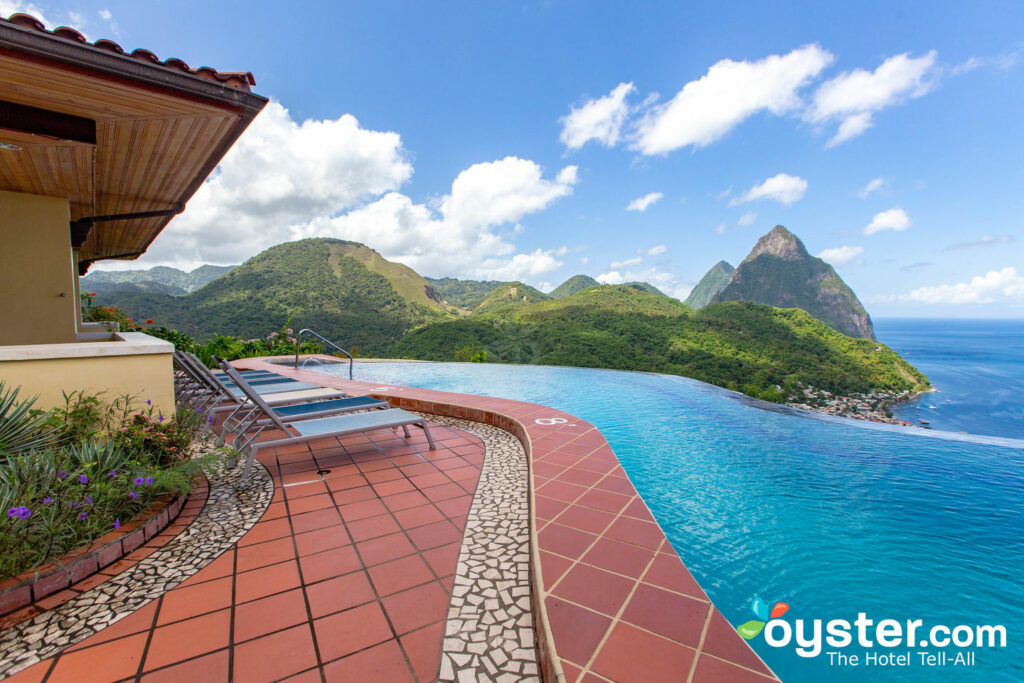
This Hotel Also Featured In
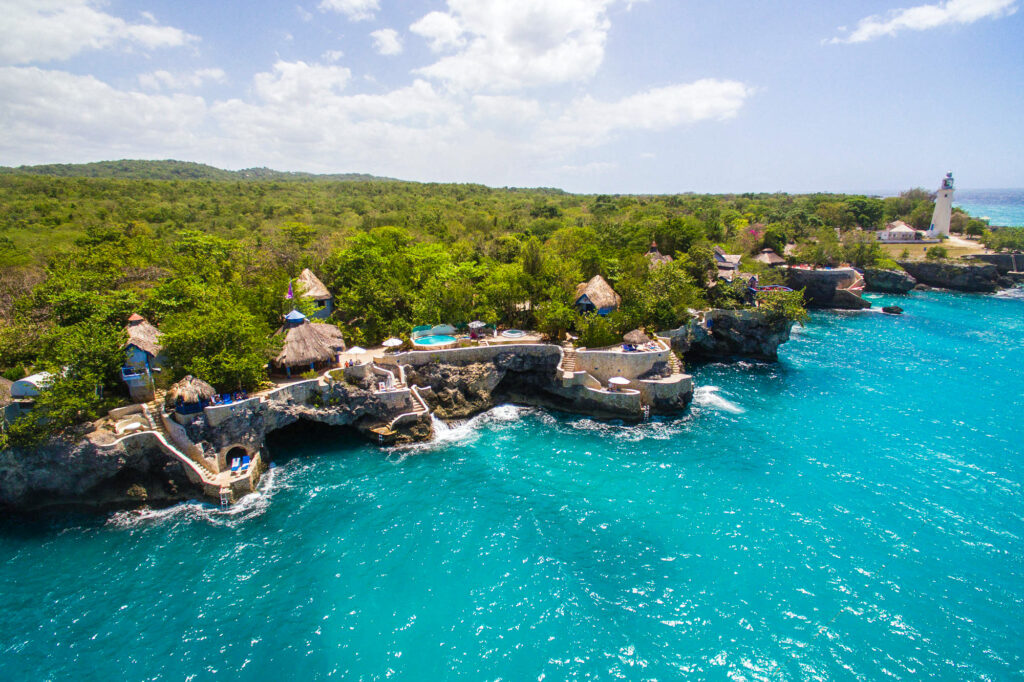
10 Most Popular All-Inclusive Resorts of 2019
We at Oyster.com love undiscovered, under-the-radar hotels, but there’s something to be said about the well-liked, well-trodden resorts, too. After all, they lure visitors year after year with impeccable service, impressive amenities, and upscale atmospheres. From the Caribbean to Mexico, there’s no shortage of all-inclusive resorts around the world. But which properties are the most…
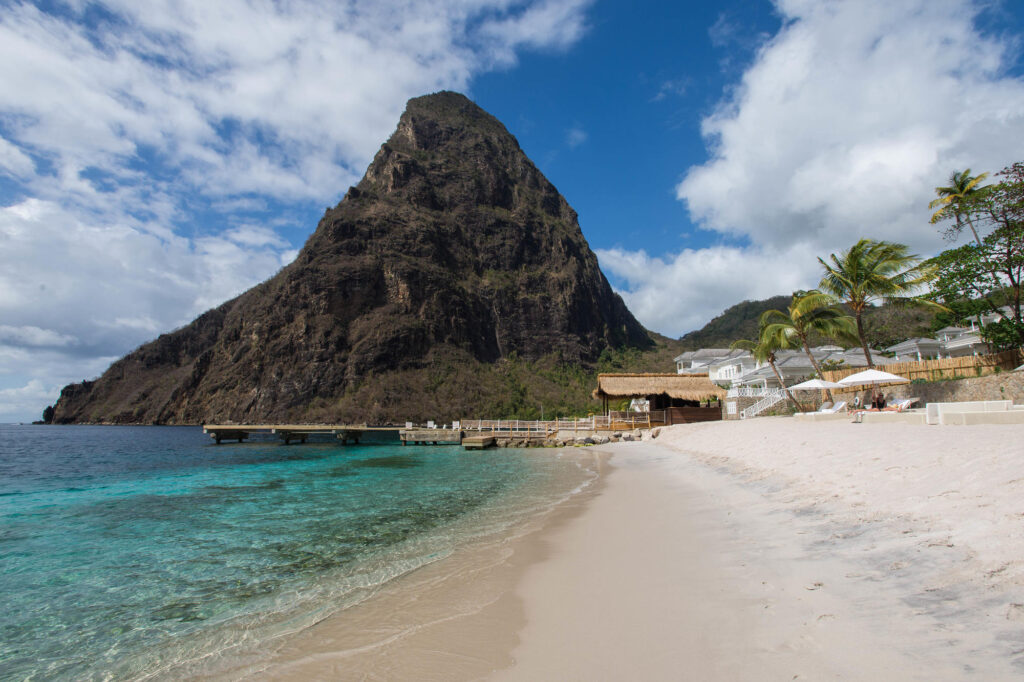
5 Luxury Hotels in St. Lucia and Their Cheaper, Similar Alternatives
From the white-sand beaches to the rugged mountains, St. Lucia’s natural beauty is exceptional. And fortunately, most hotels embrace the island’s landscape, allowing guests to immerse themselves in the stunning surroundings. However, with their breathtaking scenery and stellar amenities, these luxury accommodations come with a hefty price tag. The good news: Despite its modest size,…
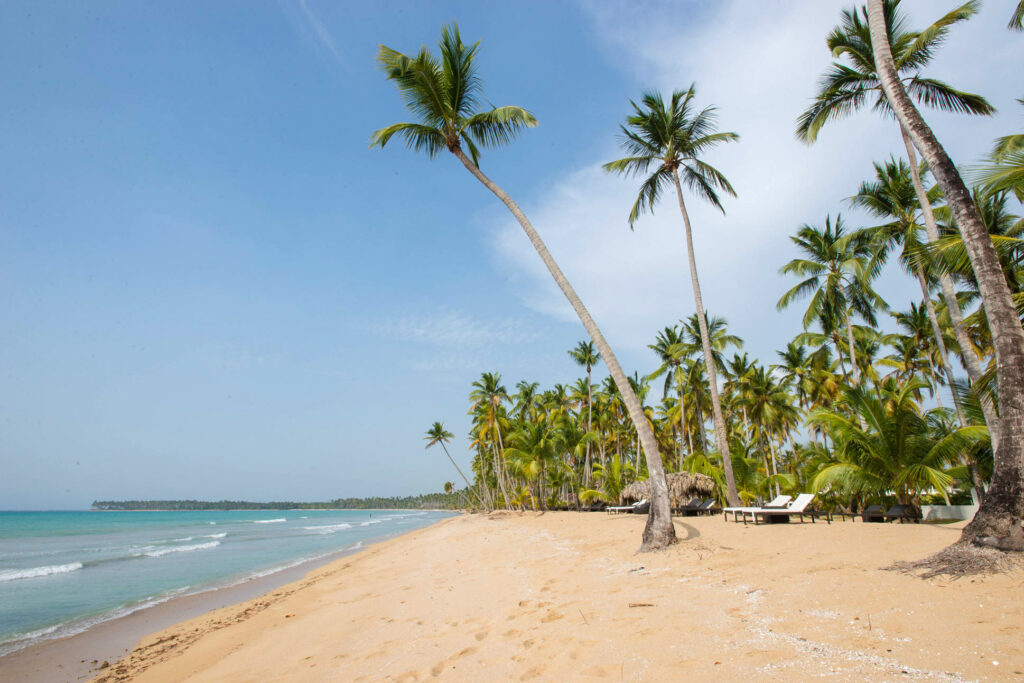
The Ultimate Cheat Sheet on Where to Go in the Caribbean
As much of North America experiences cold temps, plenty of people consider ditching their jackets for a sunny Caribbean vacation. But then comes the question of where to visit — each country in the region has its own unique atmosphere, and what could be the perfect destination for someone seeking a high-end resort with beachfront…
The 16 Most Luxurious All-Inclusive Resorts in the World
An all-inclusive getaway can be one of the best ways to unwind — your food, drinks, entertainment, and anything else you could want are taken care of without any thought on your part. During our travels, we’ve found amazing all-inclusive resorts in a wide array of categories — from adults-only to budget-friendly and family-focused properties.…
Most Romantic All-Inclusive Resorts in the Caribbean and Mexico
Many all-inclusive resorts come with rowdy pool scenes and boisterous kid-friendly activities, but there are plenty that offer a more subdued atmosphere geared toward a romantic getaway. For honeymooning couples, or families that prefer a more laid-back vibe and options for adult time, we’ve rounded up the most romantic all-inclusive resorts in the Caribbean and…
The 14 Most Beautiful Hotels in St. Lucia
Unlike many developed Caribbean islands, St. Lucia maintains a sense of unspoiled beauty. The landscapes here are some of the most stunning in the world — gorgeous beaches and lush mountains included. And that jaw-dropping beauty certainly extends to the island’s resorts, which come with swanky amenities like attractive infinity pools, chic spas, and picture-perfect…
16 Stunning All-Inclusive Resorts in the Caribbean
Swaying palm trees, fine white sand, and turquoise waters make the Caribbean one of the most beautiful destinations in the world. Adding to the scenic setting are resorts with charming architecture, well-manicured grounds bursting with bougainvillea, and lovely rooms. Travelers wanting all of that beauty combined with the convenience of an all-inclusive resort are in…
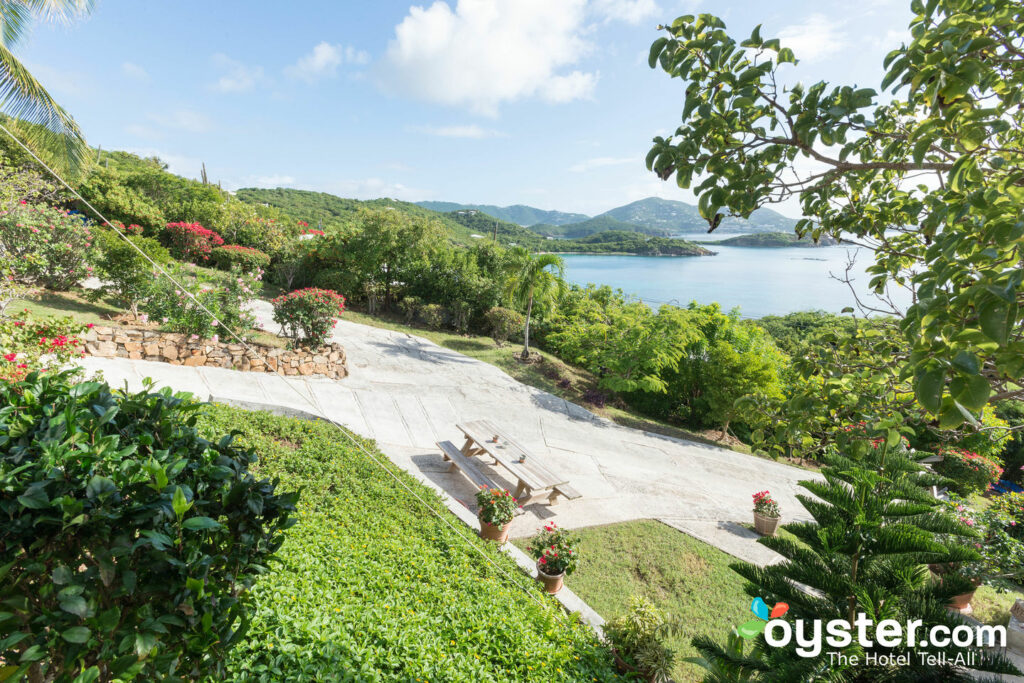
The 10 Most Secluded Hotels in the Caribbean
Hard day? Week? Month? We feel you. Sometimes, you just want to get away from it all. The city noise. The crying baby. The incessant traffic. Picture yourself on a tranquil beach somewhere far, far away. Whether you’re dreaming of a blissful vacation by yourself or a secluded trip with your significant other, we’ve got…
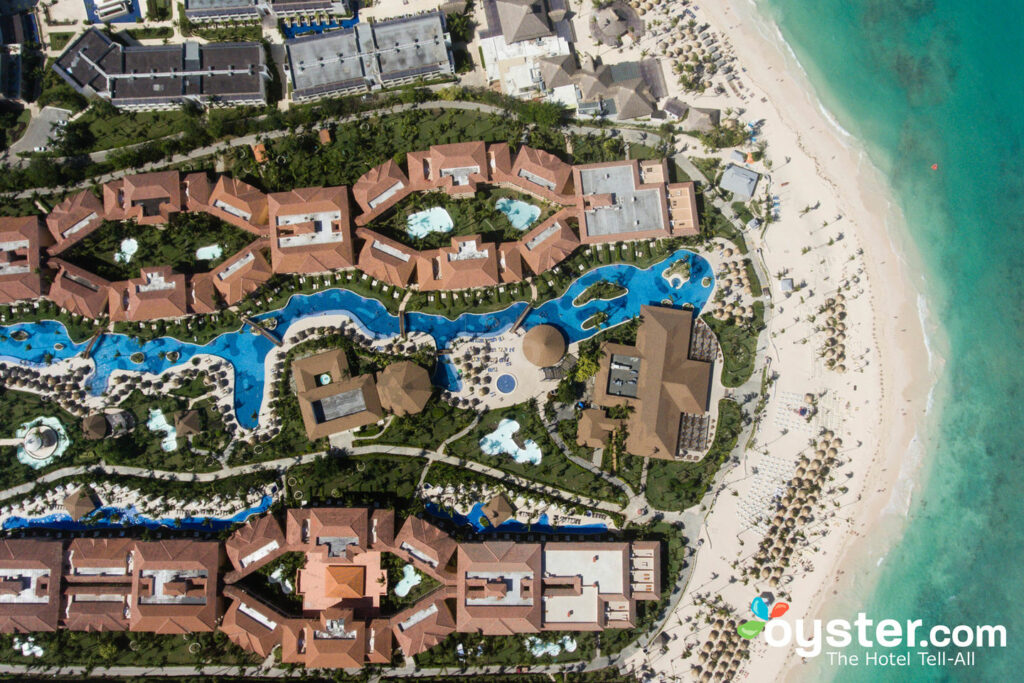
The 20 Most Popular All-Inclusive Resorts of 2018
A new year brings new beginnings, new adventures, and fortunately, even new hotels. But before we focus on the future, we’d like to take a moment to look back at this year’s most popular properties. Digging deep into our data, we found the most sought-after all-inclusive resorts around the world. Take a look at our…
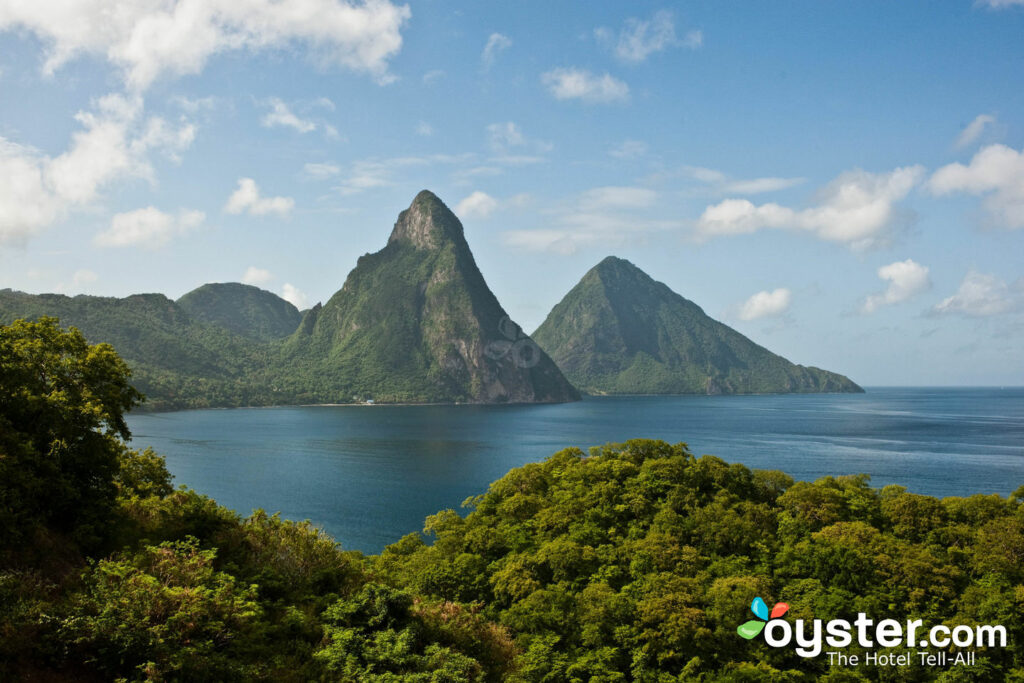
9 Caribbean Resorts That Are Worth a Spot on Your Bucket List
Everyone has their own bucket list of travel destinations — usually with common top contenders like Machu Picchu, Iceland, and the Grand Canyon. But we believe hotels are deserving of a see-before-you-die checklist, too. With that in mind, we compiled nine bucket-list-worthy resorts in the Caribbean, from St. Lucia to St. Barts, and Jamaica to…
What Are the Design and Scene Like at the Jade Mountain Resort?
One of the world's most romantic, and expensive hotels; best suited to privacy-seeking couples who appreciate quiet luxury, a bit of ruggedness, and impeccable service
Jade Mountain Resort is an architectural marvel in the Caribbean. In an effort to respect but not submit to environmental confines, owner-architect Nick Troubetzkoy built the entire resort like a tabletop, braced it against a mountain about 75 to 100 feet above the shore, and pointed it at St. Lucia's iconic Pitons, poking through the Caribbean Sea. Each of the 29 guest rooms shares the stunning view beyond its missing "fourth wall." In order to fit a whirlpool tub with an underwater light show ("chromatherapy"), a sundeck, and, in most rooms, a private infinity pool, Troubetzkoy simply quintupled the size of a typical guest room. And yet the luxury is in the details -- a constant water filtration process that keeps the pools from stinking up the rooms; a network of ceiling fans keeps the rooms from being too warm (there's no AC); and the suites are spaced far enough apart for honeymooners to join Jade in calling them "sanctuaries." Almost everyone who comes to this world-renowned, romantic boutique resort belongs to a cozy twosome celebrating a wedding, honeymoon, anniversary, or some other landmark event, and it's easy to understand why.
But Jade Mountain is not for everyone. First: No kids under the age of 16 are allowed. Second: The system of catwalks and hundreds of stairs (there are no elevators) makes it an impossible choice for anyone with mobility challenges. And the intimate, scenic serenity does have its tradeoffs. Just getting to the resort can take well over an hour on winding, nerve-racking roads. The closest beach is at Jade's sister resort, Anse Chastanet, about a five-minute shuttle ride or 300 or so stairs away. City slickers may have a hard time giving up their cell phones in public areas, and ladies will find no use for their heels here. This resort is better suited for young, sporty couples who want to experience laid-back luxury at its finest.
Taken together, it's hard to compare Jade Mountain to anywhere else on earth. But while its quiet, intimate, indisputably romantic atmosphere is unique, you can find a similar setting without sacrificing luxurious comforts at other boutique hotels like the Caves or the Geejam in Jamaica, or the Sivory in Punta Cana -- often for significantly less money. The suites at Tortuga Bay in the Dominican Republic might lack a private pool, but they're similarly sized and much closer to gorgeous beaches, private lagoons, golf courses, and the airport. And if you're looking to explore the Caribbean's natural beauty, you can stay in a room that walks right out onto the beach at Caneel Bay in the U.S. Virgin Islands, a resort surrounded by 7,000 acres of National Park.
Still, the level of service at Jade Mountain is extraordinary and tough to top -- from the turndown service to round-the-clock butlers called "Major Domos" assigned to each guest room, whose sole duty is to ensure that you have a flawless experience. Upon arrival, guests can expect to be greeted with cool peppermint-scented towels and a welcome cocktail, and check-in takes place inside the rooms. Those who arrive by helicopter will likely receive a personal welcome from the general manager himself. That said, once you're outside of Jade Mountain -- to visit Anse Chastanet's beach, for example -- service standards begin to wane. There's not much to the grounds beyond the rooms, restaurant, sky deck, and reception area, though Jade's sister resort -- a shuttle ride or hike downhill -- offers more amenities.
Where Is the Jade Mountain Resort Located in St. Lucia?
Getting to this hidden architectural marvel requires a rough road from the authentic Caribbean town of Soufriere, or a helicopter ride.
This 600-acre Jade Mountain Resort (shared with sister resort Anse Chastanet) is located on St. Lucia's southwestern Caribbean coastline, just past the town of Soufriere. It boasts incredible views, especially from Jade Mountain, which is built higher into the landscape -- about 300 steps above sea level. There are a smattering of resorts to the south, but most are concentrated near the beaches on the northwestern coast, making Jade Mountain feel a bit cut off.
How far is Jade Mountain from the airport? Reaching Jade Mountain Resort requires an adventurous, and at times terrifying, 90-minute drive from Hewanorra International Airport in Vieux Fort. Roads around the island are filled with hairpin turns, massive potholes, and serious inclines -- and the last 10 minutes of the journey will take you up a steep, one-lane dirt road. Finding the resort is also tricky (don't expect much in the way of signage); if you do rent a car, be sure to get four-wheel drive and exercise caution. Many guests choose to take a taxi or arrange a private driver; some even take a helicopter ride to the resort's own helipad, which will cut the travel time to the single digits. Once on-site, free shuttles are available to get around the grounds, or guests can hike and get a workout.
Unlike in more developed Caribbean islands, this area of St. Lucia doesn't offer much in the way of touristy dining, shopping, or nightlife, which is why many choose to stay here to begin with. Once you're at Jade Mountain, you'll likely stay here, unless taking a guided tour to Tet-Paul nature trail, the Diamond Falls, and La Soufriere Sulphur Springs. (These popular attractions are more convenient for guests staying in this area than those staying on the northwestern shore as they're all much closer to Soufriere than Castries). Those who want to explore other restaurants and bars can head to nearby luxury resorts Ladera and Viceroy -- both 15 minutes away by car. Other than this, guests can expect to isolated from virtually everything and everyone -- aside from a rooster crowing at dawn, or tree frogs singing their nightly chorus.
What Are Rooms Like at the Jade Mountain Resort?
Eco-friendly sanctuaries are intentionally tech-free, with no TVs or radios to disturb the peace or Piton views, and most have private plunge pools.
Few guest rooms around the world, can compare to those at Jade Mountain. While a select few architects have attempted to mimic the missing fourth-wall design, opening the rooms to the elements (and bugs), the seamless integration of the infinity pools (in all but the five Sky Jacuzzi Suites) and stunning views of the iconic Pitons and the Caribbean Sea give Jade's suites a considerable edge over the rooms at other leading Caribbean hotels, such as those at Caneel Bay in the U.S. Virgin Islands or the Caves and Round Hill resorts in Jamaica. Like these competitors, the guest rooms are intentionally tech-free -- no TVs or radios to disturb the peace (though there is Wi-Fi). You better love your company (or at least your book); there's little else to entertain.
The 29 sanctuaries are all huge, with 15-foot ceilings, and categorized as Sky, Star, Moon, Sun, and Galaxy -- the latter being the largest. Interiors incorporate more than 20 different species of tropical hardwood (each one varies in appearance), and walls are made of coral plaster from Barbados. A network of ceiling fans keep the rooms from being too warm (there's no AC), and king-size four-poster beds come with mosquito netting -- both romantic and necessary. As there's no fourth wall, mosquitoes, other bugs, and birds can be a nuisance, especially in summer months. In addition to the netting, the resort also regularly fumigates and provides ample insect-repellant candles and plug-in devices.
Each room also comes with a comfortable lounge area, dining table, minibar, and tea- and coffee-making facilities, as well as two cushioned sun loungers facing the sea and Pitons. Bathrooms, for their part, are massive, with double-vanity sinks, walk-in rain showers with six body sprays, Molton Brown toiletries, bathrobes, and slippers. Each chromotherapy whirlpool tub is mounted on a pedestal, and colors can be adjusted based on mood, like blue for calmness, or red to energize and activate blood flow. Nothing divides the bathroom (ahem, toilet) from the rest of the room, so couples might need to broaden their level of intimacy.
The built-in infinity pools are included in 24 sanctuaries, and range from 450 to 900 square feet -- the higher the room category, the bigger the pool. They are surfaced with glass tiles, and each pool (and correlating bathroom) has its own color scheme. Pool water is filtered and sterilized without chemicals about six times each day, so guests will never experience any algae buildup or chlorine stink in the rooms. Another romantic factor: Pools are equipped with fiber optics to illuminate them at night, which guests can control.
The five Sky Jacuzzi Suites are located on the lower hillside level of the resort. These are the only rooms without a built-in infinity pool, though they still boast 1,650 square feet of space and have the large chromotherapy whirlpools with views. One of the Sky Suites on the northeast corner has windows and air-conditioning.
Rooms are reached via private outdoor hallways; guests will know which hallway is shared (like the one to the restaurant), and which is private by the unique glass color system. A welcome spread with sparkling wine and fruit is provided for arrival, and evening turndown service might include a note from the manager, a surprise bubble bath, or beautiful towel art with some flower petals strewn on the bed.
What Features Are Available at the Jade Mountain Resort?
A public outdoor pool, spa services and a gym, free daily yoga classes, hiking trails, and mountain biking (all free), plus access to a sister resort's beach
Guests have access to activities and facilities of Anse Chastanet, which is a hike downhill (or five-minute shuttle ride). The sister resort's two beautiful soft-sand beaches are dotted with sun loungers and umbrellas; guests can enjoy food and drink on their loungers (they just put up a flag when they want their order taken) or at the beachfront restaurant. This part of the sea offers pristine coral reefs for snorkeling, and the resort provides kayaks, stand-up paddleboards, and windsurfing (all free) -- though windsurfers should know the water tends to stay calm. Sailing, fishing, and snorkeling excursions are offered on a regular basis, and there's a PADI-certified scuba center with a full diving program. Just note that the sand is a bit darker than at Sugar Beach.
Back uphill at Jade Mountain is a shared infinity pool located in the restaurant, provided mostly for the Sky Suite guests who don't have pools -- though few actually use it.
There are multiple trails on the resort's 600 acres and surrounding area for hiking, walking, jogging, and biking, allowing guests to take in the magnificent scenery while enjoying some exercise. Daily escorted tours are led by Resort Guides, and are free with the exception of those that include transportation. Those who want to rent Cannondale mountain bikes can visit the biking center on-site. Some guests may opt to tour major attractions outside of the grounds such as the botanical gardens, Sulphur Springs (a volcano where travelers can drive right through the crater), and hiking tours up Gros Piton mountain.
The spa, Kai en Ciel, is fairly basic for a hotel in this price range -- with no sauna or steam room -- and treatment rooms are located next to reception. Many choose the in-room option instead. Spa services have received mixed reviews so serious spa-goers might prefer the Rainforest Spa at Sugar Beach. The fitness room with Cybex equipment is also small, but the view is incredible and personal trainers are available upon request. There are three (free) daily yoga classes -- one here and two and Anse every day but Saturday -- given by the resident yoga instructor; they are open to all levels.
Free Wi-Fi is available throughout the property and there is a desktop computer in the reception area. A concierge is also available to assist with any request beyond the scope of private butlers.
What Restaurants and Bars Are at the Jade Mountain Resort?
Local, organic produce grown on-site is used to prepare international cuisine for the well-regarded restaurants; all-inclusive meal packages are available.
Anyone even slightly concerned with keeping the final bill in check might want to sign up for a meal package -- especially given the resort's seclusion. One option includes breakfast and dinner, and the other is all-inclusive, covering all meals and most drinks. Many guests report that the all-inclusive plan is the most cost-effective choice.
Jade Mountain Club is exclusive to guests of Jade Mountain Resort. The chic, open-layout restaurant has more of those stunning views, and the cuisine was conceptualized by James Beard Award winner Chef Allen Susser. It serves gourmet international fare (with seasonal influences) for all three meals, and the menu changes regularly (the dinner menu typically changes nightly). Guests can start and end the night with cocktails on the sky deck, and on some evenings there is live jazz or an acoustic guitarist. Guests who want privacy can order room service; staff will deliver a four-course meal and a bottle of wine. Private dining can also be arranged at other locations such as the beach down below.
Much of the produce is organically grown on the resort's Emerald Estate plantation -- the hotel offers tours of the gardens -- and the seafood is local, while beef is imported from the U.S. The food here is great, no doubt, but like anywhere in the Caribbean, the setting will often be more memorable than your food.
There are other high-quality restaurants a shuttle ride downhill at the Anse Chastanet resort, such as the Tree House restaurant (with Caribbean fare and great breakfasts), Emerald's (vegetarian cuisine), Trou du Diable (Caribbean and Creole food by the beach), and a beachfront vegetarian Indian restaurant, Apsara. In addition, the Jungle Grill on the Anse Mamin beach is known for its burgers -- it is accessible by kayak from the main beach and great for lunch.
Adventurous types who want to experience local culture can check out a handful of bars and restaurants in and around the authentic town of Soufriere. Ask the resort to provide transportation.
Hotel & Amenities Photos
Best Rates
Amenities
-
Air Conditioner
-
Airport Transportation
-
Balcony / Terrace / Patio
-
Beach
-
Concierge
-
Cribs
-
Dry Cleaning
-
Fitness Center
-
Internet
-
Jacuzzi
-
Laundry
-
Meeting / Conference Rooms
-
Pool
-
Poolside Drink Service
-
Rental Car Service Desk Onsite
-
Room Service
-
Separate Bedroom / Living Room Space
-
Spa
-
Tennis Court
Disclaimer: This content was accurate at the time the hotel was reviewed. Please check our partner sites when booking to verify that details are still correct.